
What Winston County Deed Records Actually Transfer
The Winston County Judge of Probate Records Department is where land instruments get recorded. One deed transfers only the interest its text describes. A mortgage, easement, judgment, or plat can touch the same land. But each does a different job. So read the document type, the parties, the execution and recording dates, the legal description, and any reservations as one package.
| Deed form | Recorded effect | Typical research question |
|---|---|---|
| Warranty deed | Conveys the stated interest with warranties written into the instrument | Ordinary arm's-length conveyance |
| Quitclaim deed | Conveys whatever interest the grantor has without promising its extent | Family transfer or interest cleanup |
| Limited or special-warranty deed | Uses warranties limited by the document's language | Entity or negotiated transfer |
| Executor, personal-representative, or trustee deed | Transfers through an estate or fiduciary capacity | Death-transfer and probate trail |
| Tax deed | Documents a tax-sale route subject to Alabama procedures | Delinquent-tax history |
A label by itself proves nothing. Whether the grantor held good title, or whether another interest still clouds the parcel, depends on the operative clauses and the full recorded chain.
Winston Probate Is the Deed-Room Starting Point
Start with the county-authorized online services. They cover the land-record lookup route, probate-case lookup, account login, and search instructions. The related Ingenuity records service explains county selection plus round-the-clock viewing and copy purchasing. The dynamic deed query offers no dependable direct URL. The county also does not publish the first year indexed online. That gap deserves respect. Never treat the oldest result from one name search as a coverage date. Call or visit the Probate Records Department. Ask there for the grantor-grantee index, a deed book and page, a plat book, or older formats. A record-account login and paid images are access tools. They do not prove every historical deed is digitized. The Winston Probate landing page shows the county-authorized routes a deed researcher can use.
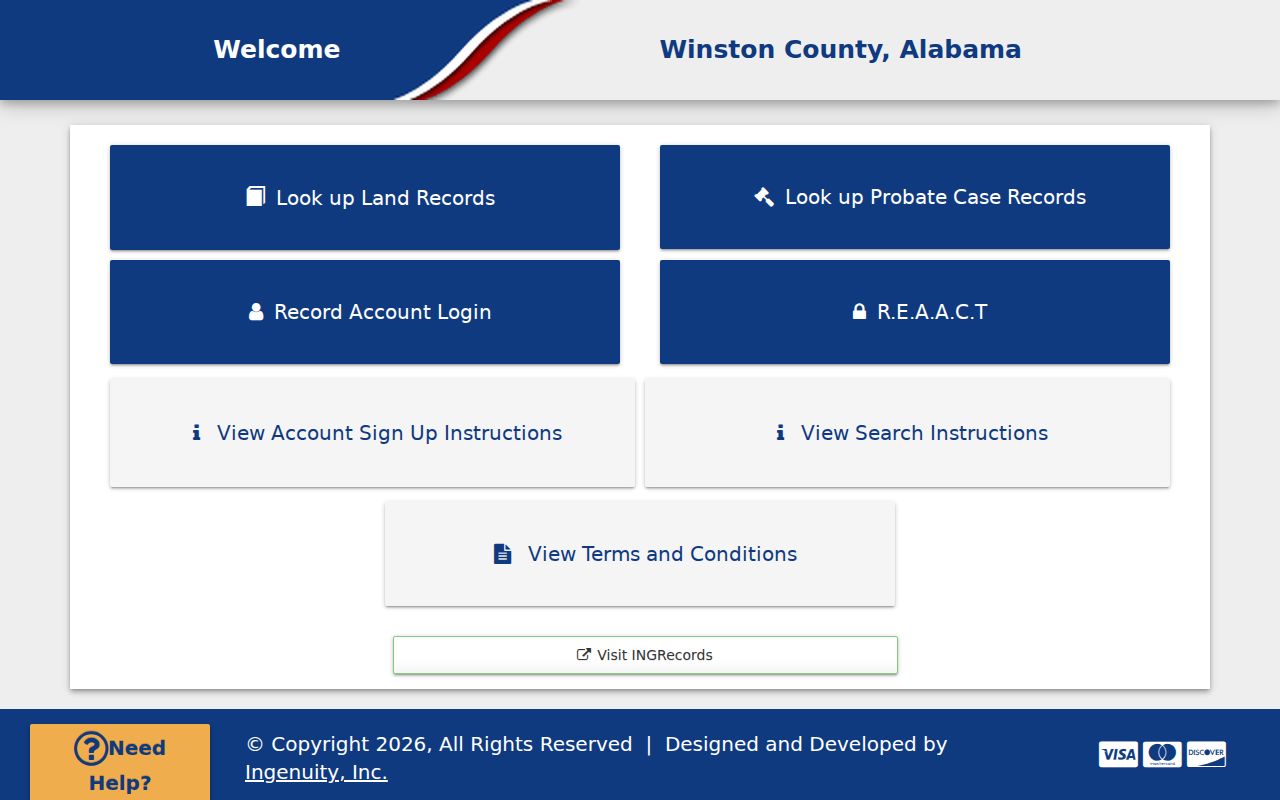
Treat that page as the stable starting address when the vendor's search session changes underneath it. The Ingenuity service page explains the wider county-record viewing and copy system.
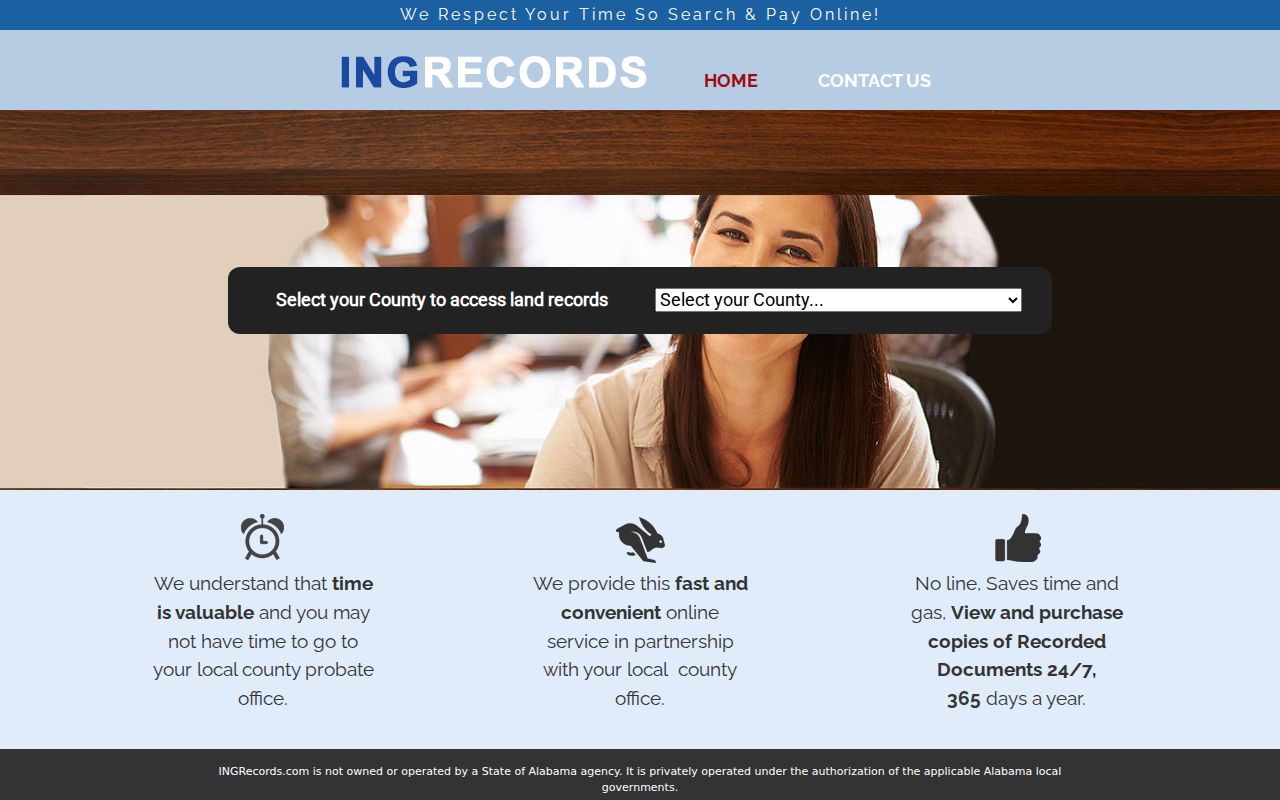
The service page clarifies how online access works. The Winston Probate custodian still holds responsibility for the county's deed record and any certified copy.
Note: No official Winston County property-fraud alert signup was located, so the online R.E.A.A.C.T label should not be described as a confirmed alert service.
Walk the Winston Grantor-Grantee Index Backward
Begin with a current deed reference pulled from the tax card or GIS, then confirm it in the recorded index. Names shift through marriage, estates, entity conversions, and stray punctuation. Search the variants and compare land descriptions instead of trusting a name alone.
- Locate the present owner's acquisition deed with the present owner as grantee.
- Read the grantor, recording date, deed book/page, and complete legal description from that instrument.
- Search that grantor as an earlier grantee and compare the land description, acreage, exceptions, and adjoining-owner calls.
- Repeat through each transfer; follow probate, court, or tax-sale records when a conventional deed is absent.
- Move to physical indexes, deed books, plats, microfilm, or Archives material when the online trail ends.
A grantor transfers the stated interest. A grantee receives it. The chain of title is the ordered sequence of instruments for the same land. A book/page citation points to a volume location, while an instrument number marks a recorded filing under a separate indexing scheme. Keep whichever label Winston Probate uses.
Carry Book, Page, and Legal Description Together
The Winston tax and GIS layer can display DeedBook and DeedPage fields beside the parcel, owner, situs, subdivision, and legal description. Treat those as leads, not substitutes for the recorded image. Then match section-township-range, the point of beginning, courses, distances, road rights-of-way, creeks, lot and block, acreage, exceptions, and plat references against the deed itself.
| Party names | Grantor, grantee, joint parties, entity suffixes, and fiduciary capacities |
|---|---|
| Dates | Signed, acknowledged, and recorded dates, which may differ |
| Reference | Book/page or instrument number used to retrieve the image |
| Land identity | Legal description, subdivision/lot/block, acreage, and prior references |
| Terms | Reservations, easements, life estates, restrictions, and consideration language |
A GIS subdivision string like "MB 3 PG 25-26" or "SLIDE 151A" is a signal. The same goes for a restrictions reference. Each one should prompt a separate plat or declaration request.
Deeds, Mortgages, Releases, and Judgments Form One Trail
The Winston Probate fee schedule shows the office handling deeds, mortgages, easements, releases, affidavits, powers of attorney, judgments, MERS items, and UCC statements. A deed can name the owner of record. An unreleased mortgage, easement, judgment, or restriction can still bind the parcel. For mortgage and judgment releases, use the Probate office's release resources. Court pleadings, quiet-title litigation, partition, foreclosure disputes, and mechanic's-lien enforcement belong with the Winston Circuit Clerk. State UCC records can add a debtor-name lead. They never replace county real-property indexing.
The 1891 Fire Changes Old Winston Deed Research
Winston County began as Hancock County in 1850. It took its current name in 1858. The county seat later moved from Houston to Double Springs in 1883. An August 1891 courthouse fire destroyed substantial county material. A missing early deed may reflect loss, later custody, reconstruction, or an index gap rather than proof that no transaction occurred. The Winston County Archives guide lists a probate fee book beginning in 1891 and a probate general record for 1891 through 1899. It also notes three pre-1900 plat books, tax and redemption records starting around 1891 and 1892, lot books, mortgage-tax material, and newspapers from 1908 with some years missing. Ask whether an absent deed survives in a later deed recital, a plat, an estate record, or a tax book. It could also appear in a redeemed-land entry or a newspaper notice.
Note: Search both Houston and Double Springs as historical place clues when a nineteenth-century record crosses the county-seat transition.
Obtain a Winston County Deed Copy
Copies of a Winston County deed come from the Records Department, and precision speeds the request. Online viewing may run through the authorized vendor. In person or by mail, supply the grantor and grantee. Include the approximate recording date, the deed type, and a book/page or instrument number. Add the legal description, too. For older land, include the township or community and any plat reference. Say whether a plain informational copy or a certified copy is wanted. Enclose the self-addressed stamped envelope the office asks for.
The published general recording charges are $4 for the first page. Each additional page is $3. Certified copies are listed at $3. Fiche, computer, or book copies run $1. A release's first page is separately listed at $5. Deed tax, mortgage tax, extra party names, MERS entries, attachments, and nonstandard instruments can all shift the total. Ask the office for a current estimate before sending payment.
The Probate fee page states deed tax at $1 per $1,000. Rounding goes to the next $500. Mortgage tax is stated at $0.15 per $100, also expressed as $1.50 per $1,000. Confirm the printed deed-tax notation at the counter rather than recalculating from a summary. The official Winston recording-fee page carries these deed-record copy and filing charges.
The fee schedule is a solid planning reference. Still, the Records Department should price the actual instrument and certification requested.
Recorded, not guaranteed. Winston County deed records show instruments accepted for recording. They do not supply a title opinion, prove an unrecorded interest does not exist, or resolve every defect in a chain.
Finish the Deed Search with the Right Custodian
Match each question to the right Winston County custodian. A Winston County property search works only for establishing the parcel and current tax clues. Probate holds the deed, mortgage, release, easement, judgment recording, and plat. The Circuit Clerk keeps the case file behind a quiet-title order. Partition suits, foreclosure disputes, and judgment enforcement live there too. The Archives covers older books and bridging evidence. Keeping these channels separate stops a costly mix-up. A tax owner, docket entry, or map annotation then cannot be mistaken for the recorded conveyance.
For a formal chain, record every source, search date, spelling, negative result, and gap. Compare the complete legal description at each link. Obtain certified copies of any instrument you will rely on. Qualified title professionals can then judge whether the assembled deeds and encumbrances establish marketable ownership.
Use Tax and Plat Clues without Replacing the Deed
The Winston property-tax search can hand you the current owner string, parcel identifier, situs, tax year, description, and a starting deed reference. The ISV layer adds subdivision, lot, block, acreage, deed book/page, and geometry. These are efficient discovery aids. They help most when a party name is misspelled or the same surname appears again and again.
But a parcel can be split, combined, or still carried under an older roll owner. The tax map may also simplify a legal boundary. Once the clues point somewhere, retrieve the instrument and compare every land call. If the GIS shows Rock Creek Estates lot 1 or Scenic Estates with plat book 3 pages 25-26, request that plat and deed instead of assuming the displayed polygon is the recorded boundary.
Build a Reproducible Winston Deed Record File
For each link in the chain, record the exact indexed name, capacity, and deed type. Note the signed date, recording date, and book/page or instrument number. Add the legal description and the source. Note whether the copy is a screen result, a plain copy, or a certified copy. Keep unresolved differences visible. A changed road name, inconsistent acreage, missing spouse, life estate, exception, or prior-book citation all belong in the file.
When an online search comes up empty, state the mode, spelling, and date range. Also record the date searched. Do not conclude that no deed exists where online coverage is undisclosed. Repeat the search under name variants. Use the reverse index, and ask the Records Department about older books. Consult Archives evidence where the 1891 fire or a custody change may explain the break. That discipline turns scattered deed records into an auditable history without claiming more than the documents support.