
Read a Winston County Property Tax Record by Field
Winston County's Revenue Commissioner handles both assessor and collector duties, so one office's trail covers the whole tax record. Read each field as the answer to a narrow question for a single tax year, not a blanket reply to what a property is worth.
| Tax-record field | Meaning in the record | Official source |
|---|---|---|
| Appraised or total value | County estimate used before the classification ratio | Winston Revenue tax record |
| Assessed value / TAV | Value after the statutory classification rate | AssuranceWeb detail |
| Land and improvement values | Components making up the parcel valuation | Tax card and GIS attributes |
| Exemption indicator | Tax treatment allowed or claimed for that year | Revenue assessment record |
| Total tax and balance | Displayed charge and unpaid balance for the selected account/year | AssuranceWeb result |
| Tax district and tax year | Geographic levy context and annual snapshot | Tax/GIS data |
A displayed tax balance is not a sale notice. An exemption flag proves neither title nor current occupancy. For anything you intend to rely on, confirm the status directly with Winston Revenue first.
Use AssuranceWeb's Tax-Year and Search Controls
The free Winston County AssuranceWeb search opens with 2025 as its default tax year. Pick your year deliberately. Results reflect only the year selected. The search modes differ by purpose. Name, PIN, Company, Parcel, Account, Subdivision, and Address each query the tax roll differently. Matching the right mode to the identifier you hold saves time and avoids false misses.
| Search mode | Enter | Tax-review use |
|---|---|---|
| Address | Street number in Criteria 1; road text in Criteria 2 | Find a known physical property |
| Name or Company | Displayed taxpayer name, with Starts With or Contains where offered | Locate accounts under a person or entity string |
| PIN / Parcel | The identifier under its matching label | Return to a precise tax parcel |
| Account | Billing account number | Find the corresponding account record |
The Winston tax portal home sometimes shows online payments disabled. That notice is temporary. It is no sign that a displayed balance has been forgiven. It also does not mean the account is delinquent. Instead, contact the office directly for a current tax bill or the proper payment route. Treat the portal home as a display of your parcel's tax-year data rather than a payment confirmation.
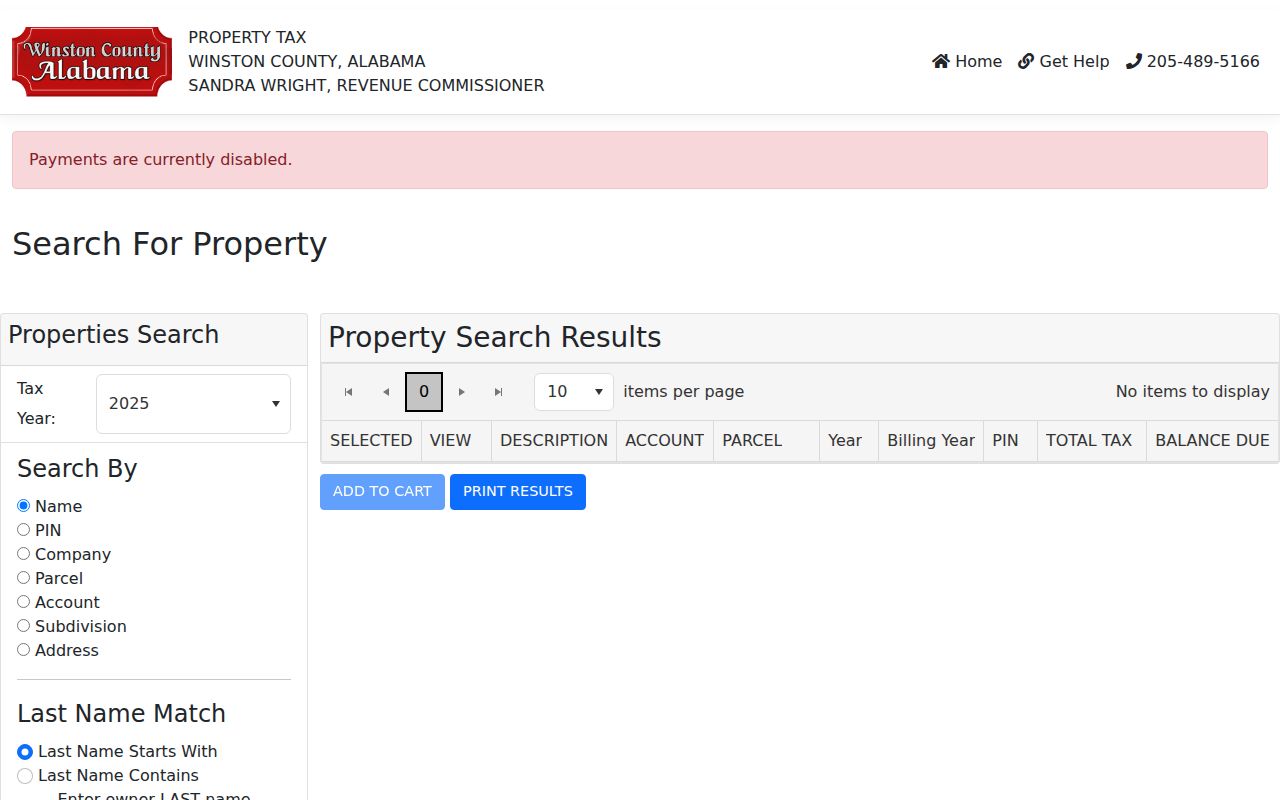
The portal image helps you land on the correct Winston County site. A current bill or receipt still has to come from Revenue.
Look Up a Winston County Tax Bill in Four Checks
- Select the required tax year and search by address, PIN, parcel, or account.
- Match the situs, parcel identifier, description, and owner string before reading the totals.
- Open the detail and record appraised/total value, assessed value, land and improvement components, exemption, tax district, total tax, and balance.
- Ask Winston Revenue for a current statement, payment status, or delinquency confirmation when the web payment feature is unavailable or the stakes require an official answer.
Appraised or market value is the county's estimate of fair-sale worth. Assessed value applies Alabama's classification percentage to that figure. A millage or levy then converts assessed value into an unadjusted tax amount. A homestead exemption trims eligible taxable value. A tax lien is a legal claim tied to unpaid tax. It never arises just because a balance field shows a number.
Save or print any result with its search date and tax year. The next annual update can change the owner of record, values, exemption, or balance on the tax roll.
Separate TTV, TAV, Land, and Improvements
The Alabama Department of Revenue lays out the math in a fixed order. Appraised value multiplied by the classification rate yields assessed value. Assessed value multiplied by millage yields the unadjusted tax. Exemptions apply after that. So the values on Winston County property tax records are related but never interchangeable.
One public Highway 195 parcel illustrates the point. Its record showed several figures. These included TTV 5,100, TAV 520, land value 5,100, improvement value zero, and total tax due 14.56. It also listed TaxYearDue 2027 while the web interface defaults to 2025. That mismatch is a year-reading risk, not a valuation rule or a universal bill.
Sale price belongs to the deed trail instead. A market estimate, a taxable assessment, a displayed balance, and a recorded deed amount can all differ. Each one serves a different purpose, and each has good reasons to differ. Compare them side by side rather than collapsing them into one number.
Note: A blank improvement or exemption field should be verified with Revenue rather than interpreted as proof that no building or qualifying use exists.
Alabama Classification Rates Shape Winston Assessments
The state assessment guidance sorts property into classes. Class I utilities assess at 30 percent. Class II property, when not otherwise classified, sits at 20 percent. Class III covers agricultural and forest land. It also includes qualifying owner-occupied single-family and manufactured-home property. Qualifying historic property falls here too, at 10 percent. Class IV private passenger vehicles and qualifying pickups carry 15 percent. Whatever class the actual Winston parcel shows controls its assessment.
Alabama also reappraises one-fourth of each county every year. A full equalization cycle runs over four years. Improvements should be reported by December 31. The upshot: a tax roll entry is an annual assessment snapshot. It is not a live description of a new build, sale, split, or ownership change.
Act 2024-344, also cited as HB73, adds a wrinkle. It caps the percentage increase in taxable assessed value at 7 percent. The cap applies to qualifying Class II and Class III real property. Winston County shows no dedicated cap field. So confirm eligibility and application with the local office.
Read a Winston Homestead Flag Carefully
The Alabama homestead guidance ties relief to a qualifying owner-occupied single-family dwelling. It also covers up to 160 acres occupied on the first day of the tax year. Categories such as H-1, H-2, H-3, H-4, age, income, disability, and blindness affect different portions of the bill. Those portions include state, county, and school amounts. Winston Revenue decides the local application on current evidence and law.
Treat a homestead flag as tax evidence for one assessment year. It does not prove the displayed owner holds full title. It does not show the owner lives there today, or qualifies in another year. Bring parcel identification and whatever proof Revenue requests when applying or correcting the record.
October, December, and May Mark the Tax Cycle
Under the Alabama property-tax timetable, taxes come due October 1. They turn delinquent after December 31. Delinquent accounts generally move to Probate in February. Probate court meets in March. Advertising runs in April. May is the usual sale period. Current Winston notices and account confirmation control.
The state delinquent-property guidance separates transcripts, payoff quotes, assignments, sales, redemption, and tax deeds. A balance in AssuranceWeb alone does not signal a pending sale. Get the current notice, parcel identity, costs, deadlines, and status from the responsible county office.
Protest a Winston County Assessment on Time
An owner who disagrees with a written valuation notice generally has 30 days to file a written protest with the County Board of Equalization under Alabama Code §§40-3-20, 40-3-24, and 40-3-25. Confirm the current form, filing address, triggering notice date, and delivery method with Winston Revenue rather than treating a general state page as a local filing instruction.
Identify the owner and parcel, quote the disputed valuation, state specific grounds, and attach evidence. A recent arm's-length sale, comparable properties adjusted for real differences, photographs, repair estimates, a survey, a corrected parcel description, or documentation of a classification or exemption issue can help the board understand the claim. Keep proof of timely delivery.
Appeal window. The ordinary county Board of Equalization protest period is 30 days after the written valuation notice. Verify the exact deadline and filing route with Winston Revenue immediately after receiving the notice.
The Tax Tribunal and circuit court are not substitutes here. Those state routes serve certain final state assessments, so follow the appeal rights printed on the actual decision instead of treating them as a county real-property protest.
Recent Winston Land Activity Adds Context, Not Tax Proof
The current ADEM Winston County page tracks environmental and development records across the area. Listings include Slick Ford, The Shores at Smith Lake, TVA work, Rock Creek Sand and Gravel, and Double Springs infrastructure. A September 2025 notice involves American Fiberglass at 101 Industrial Park Road in Double Springs. These entries can explain visible site activity and point a researcher toward permit documents.
A permit applicant is not necessarily the fee owner. A permit is neither a tax assessment nor a deed. Treat the ADEM clue as a lead back to the parcel and Winston County property tax records. It also points toward recorded land instruments. For ownership, follow Winston County deed records. For boundary context, use the parcel map guide. The official Alabama assessment page supplies the broader framework.
The image adds assessment context. The Winston parcel record and the local Revenue office supply the property-specific figures. The state due-date page covers payment timing and protests.
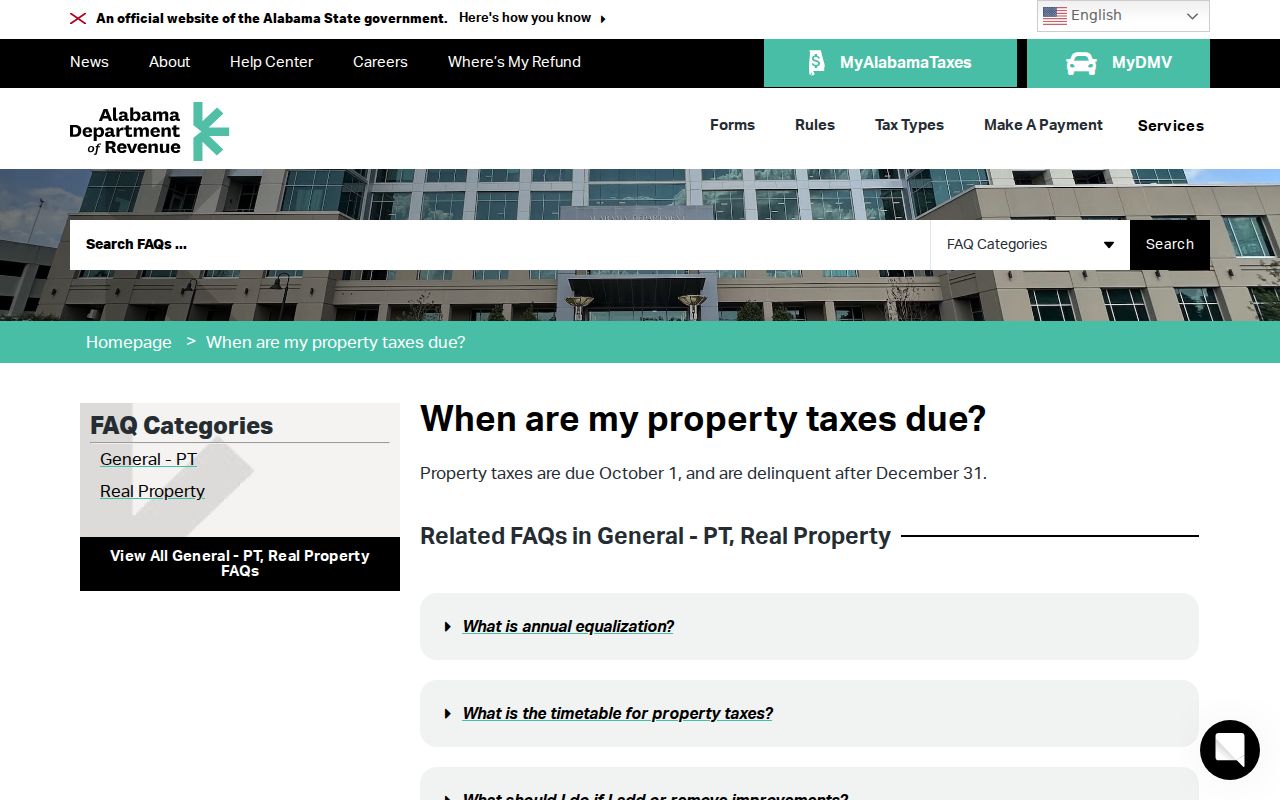
Use those statewide dates as a framework. Confirm the current Winston County notice and account status with Revenue before taking any action.
Preserve the Tax Year in Every Comparison
Match the parcel number first. Then confirm the tax year. Comparing two Winston County property tax records across mismatched years invites error. An owner update, new improvement, exemption decision, classification change, reappraisal, parcel split, or payment posting may each land on a different schedule. Save the search date and the source view. Ask Revenue to explain any field that seems stale or conflicts with a written notice, so an annual roll snapshot never masquerades as a real-time account statement.